The original social network: a history of business cards
After centuries of introductions, there are still new ways to say hello.
-
 The MOO Team

Share the post


Before you could slide into someone’s DMs or send a LinkedIn request, introductions happened on paper. The internet has given us plenty of new ways to say hello, but it hasn’t killed off the Business card.
The idea of handing over your name has a long history. The materials have changed, but giving someone something to remember you by still has its appeal.
This little rectangle has been changing hands for nearly 2,000 years, because people still want to meet in real life and leave with something to hold.
So what has made the Business Card worth keeping? From wooden visiting cards in ancient China to textured papers and QR codes, we’re tracing the evolution of a small object with a very sociable purpose.
Key takeaways
- Early ancestors of the Business Card include wooden visiting cards from third-century China.
- By the 1700s and 1800s, cards were both a social ritual and a colorful bit of advertising that people collected and swapped.
- Desktop publishing in the 1980s put design in more hands, and email addresses and websites joined the card.
- Today, textured paper and special finishes help a card tell your story, and a QR code links it to your online world.
Ancient China: putting a name in wood

Some early ancestors of the Business Card were made from bamboo and wood, with silk and paper used later. In China, these written introductions helped identify the owner and arrange a meeting.
Wooden visiting cards recovered from the tomb of Chinese general Zhu Ran date back to the third century CE, during China’s Three Kingdoms period. Roughly 1,800 years later, their inscriptions still identify the owner and offer a greeting.
18th century: the art of introduction

By the 1760s, fashionable people in France and Italy were using printed visiting cards decorated with images and space for handwritten details. Cards could announce a visitor, begin an acquaintance, or let someone know you had stopped by.
Designs ranged from simple lettering to elaborate engravings. The etiquette was equally considered. In Regency Britain, a folded corner could show you’d delivered your card personally. “Not at home” could mean your host wasn’t receiving visitors, even if they were upstairs.
Being ghosted predates the internet by a long way.
19th century: trade cards get colorful

Alongside these social introductions, businesses were putting cards to work. Promotional cards appeared in Europe as early as the 1600s, telling customers what businesses sold and where to find them. Engraving and etching brought detailed designs to paper.
In the 1800s, chromolithography added vivid color, printed in layers from separate inked stones.
People collected colorful pasteboard trade cards in albums and swapped them to complete sets. These little advertisements had become things people wanted to keep.
Production was speeding up, too. In 1889, Oscar Friedheim advertised a cutting and scoring machine that could produce up to 100,000 visiting and business cards a day. That’s a lot of introductions.
The 1980s: design comes to desktop

The mid-1980s desktop-publishing boom gave more businesses tools to arrange text and images on a computer. Technologies like Adobe’s PostScript helped turn those layouts into crisp print.
Over the following years, email addresses and websites joined job titles, office addresses, and phone numbers on the card, giving people more ways to keep the conversation going.
21st century: thinking outside the rectangle

When MOO launched in 2006, we wanted to make great design available to everyone. Business Cards had spent centuries introducing people. We saw an opportunity to make those introductions more personal, starting with MiniCards.
Printfinity took that idea further, allowing a different image on every card in a pack. The card had more of your work, and more of you, to share.
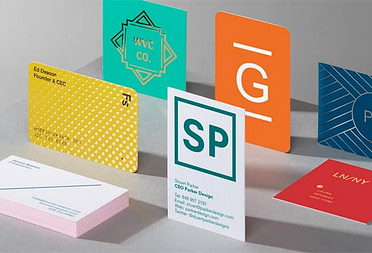
In 2012, Luxe brought extra-thick, layered paper into the picture. Our paper range has continued to grow, now including subtly textured Feltmark and Eco Signature’s uncoated paper, made from 100% recycled material.
Alongside Special Finishes such as Gold Foil and Raised Spot Gloss, these developments gave the paper and finish a bigger role in telling your story. Even a simple name and number could become something beautiful.
Today, a QR code connects that physical introduction to your online world. The card still does its centuries-old job, just with a few more ways to keep the conversation going.
Join the original social network. No password required.
Explore MOO Business Cards and make your next introduction a little more you. For bigger orders and Business Cards for the whole team, visit MOO Business Services.
Keep in touch
Get design inspiration, business tips and special offers straight to your inbox with our MOOsletter, out every two weeks.
Share the post
Keep in touch
Get design inspiration, business tips and special offers straight to your inbox with our MOOsletter, out every two weeks.