We swear it can work: a brand guide to bad language
Profanity in marketing: the good, the bad, the brilliant.
-
 The MOO Team

Share the post


A few weeks ago, we published a piece called The Shi***est Merch We’ve Ever Received. We thought we were being honest. Some people loved it. Some people hated it. The comments came in. The emails, too.
Fair enough. Swearing is a sensitive subject. We knew we were being a little provocative, but we were also being honest. We’d love to live in a world without sh*tty merch. We really care about doing things better, so we decided to be bold with our message. A little too bold? Maybe.
But it did get us thinking…
What does the science say about swearing in marketing? Which brands have pulled it off? And what can the rest of us actually learn from them?
Read on to find out.
Key takeaways
- A well-placed swear word can make a brand feel more human. A poorly placed one just makes it look desperate.
- Profanity signals passion. Passion signals authenticity. And authenticity is what every brand is chasing right now.
- The asterisk is doing more work than you think. Sometimes, almost saying it is better than saying it.
- Context is everything.
Why bad words feel so good
Research shows that swear words in product reviews are often perceived as more helpful, not less. Consumers assume that when someone swears, they’re expressing strong feelings and are willing to break a social norm to say what they actually think. Profanity is passion. Passion is human.
Humor does a lot of heavy lifting here. More than 55% of US consumers say humorous communication that makes them laugh is among their most appealing brand messages. Sometimes the right swear word is the funniest, truest word in the room.
That said, studies also show there’s a swear word ceiling. One well-placed bad word lands. A stream of them doesn’t.
The potty-mouth hall of fame
So, what does dropping the F-bomb look like in practice? We’ve rounded up five brands that have used profanity in their marketing, ranked from good to genuinely brilliant. All of them have something to teach us about when swearing works, when it doesn’t, and why the word is almost never the point.
#5. Dollar Shave Club, “Our Blades Are F**king Great”

Michael Dubin, a former improv comedian and the founder of Dollar Shave Club, shot a hilariously low-budget launch video that delivered the category-changing line. It was 90 seconds worth of total absurdity from a toddler shaving a man’s head to a giant American flag. Within 24 hours, the video attracted 12,000 subscribers, and just four years later, the start-up was bought by Unilever for $1 billion.
MOO view: The asterisk signals that a brand knows the word it’s not quite saying. That can be more hard-hitting than just saying it out loud.
#4. Archer: “Solicited D*cks”

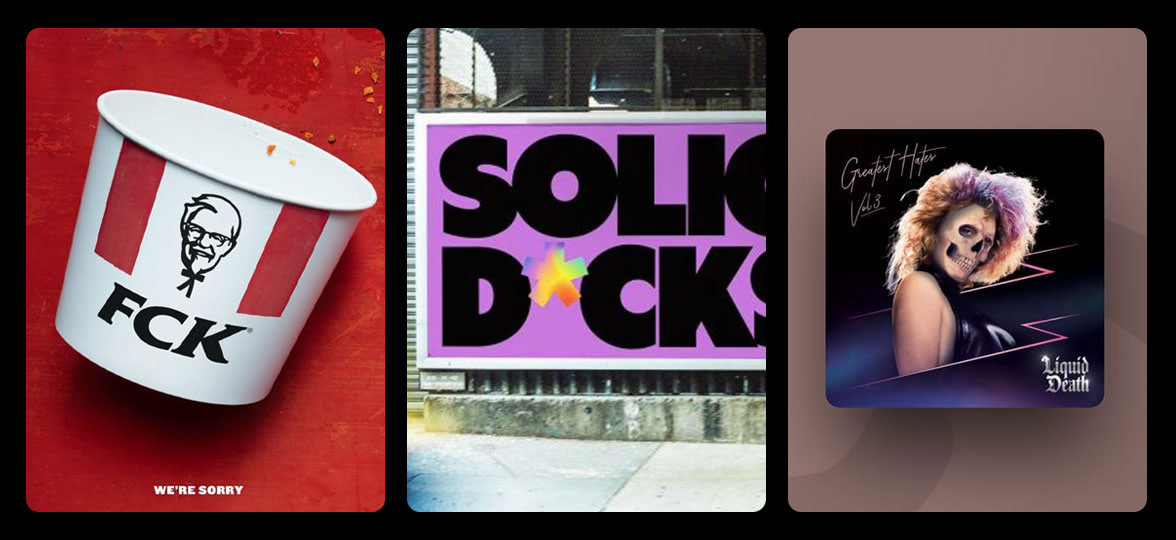
Gay dating app Archer knew its users were fed up with unsolicited explicit images on dating apps. So for Pride Month 2024, it plastered New York City with billboards in 3,000-point font that read: Solicited D*cks. The campaign promoted an AI feature that auto-blurs unsolicited nudity until the user chooses to see it. Consent, essentially, made into a headline.
MOO view: Sweary campaigns are at their best when they’re dealing with a real issue. Archer was making a point about consent that its audience genuinely cared about. We think the swear word definitely earned its place on the billboard.
#3. Frank’s RedHot: “I Put That Sh*t On Everything”

In third place, it’s our fave hot sauce. Frank’s RedHot built its entire brand personality around a single bleeped tagline delivered, in the original ads, by a deadpan elderly woman named Ethel. “I put that sh*t on everything.” The campaign has run for years, spawned a hashtag (#IPTSOE), roped in Jason Kelce for a Super Bowl stunt, and unavoidably attracted complaints for its “foul language.”
MOO view: The genius is in casting Ethel rather than someone you’d expect. Hearing that line from a poker-faced grandma is what makes it genuinely funny rather than just edgy. Anyone can swear, but not everyone can make it charming.
#2. KFC: FCK and “What the Cluck?”

When KFC ran out of chicken and had to close over 750 UK restaurants, most brands would have reached for the corporate crisis playbook. KFC reached for a bucket. A full-page ad rearranged its own three letters to spell FCK. That’s the most honest apology anyone has ever seen from a fast-food brand and it landed them an advertising award.

KFC felt ballsy the following year and went with the campaign tagline of “What the Cluck?” The ASA banned it. KFC’s defence that “cluck” was simply an onomatopoeic reference to a chicken didn’t quite wash this time round.
MOO view: FCK worked because it was earned, while “What the Cluck?” was just a pun on a Poster. Context is everything.
#1. Liquid Death: “F*ck Whoever Started This”

Our foul-mouthed champion is Liquid Death. They sell water in tallboy cans with skulls on them, and the stunts match the packaging, from a life-size casket cooler to a Tony Hawk skateboard infused with his actual blood. They are the most unhinged brand in any room.
When the hate comments rolled in, Liquid Death set them verbatim to death metal and released the results as Greatest Hates, complete with a music video for the standout track: “F*ck Whoever Started This.” The lyrics are real, uncensored social media hate comments. As Liquid Death put it, censoring them would be “watering down their true passion and authentic voices.”
MOO view: Why swear when you can get your haters to do it for you? Liquid Death took the internet’s worst and turned it into content.
Your bite-sized guide to swearing in marketing
Before you even think about reaching for the keyboard, run it through this checklist. It won’t guarantee a viral campaign, but it might save you from a very awkward email from your legal team.
- Have a reason. The word needs to be doing a job. If you can remove it without losing anything, remove it.
- Know your audience. A swear word that lands with a 28-year-old in Brooklyn might not land with a 58-year-old in Boise. Know who’s reading.
- Earn it. FCK worked because KFC had genuinely messed up. A swear word you haven’t earned just looks desperate.
- Less is more. One well-placed word lands. A stream of them doesn’t. The ceiling is lower than you think.
- The asterisk is your friend. Used well, it signals that you know the word you’re not quite saying. That knowing wink can be more powerful than spelling it out.
- Context is everything. Bus stop or brand blog? Grandma audience or Gen Z? The same word can be genius in one place and a lawsuit in another.
Great print for great brands. Even the sweary ones.
Whatever you’re trying to say, we’ll make sure it looks brilliant on paper. Business Cards, Stickers, Notebooks, Flyers. All the good stuff, none of the sh*t ones.
Keep in touch
Get design inspiration, business tips and special offers straight to your inbox with our MOOsletter, out every two weeks.
Share the post
Keep in touch
Get design inspiration, business tips and special offers straight to your inbox with our MOOsletter, out every two weeks.


