Business Card thickness, explained
Discover the ideal paper weight for your next project.
-
 The MOO Team

Share the post


Choosing the right Business Card thickness is about more than making a good first impression. It affects how your cards feel in someone’s hand, how they hold up to everyday use, and the kind of impression you make.
When you’re comparing paper stocks, you’ll come across measurements in points (pt), pounds (lb) and GSM. They don’t convert neatly, which is why the question comes up so often: what does 16pt actually mean, and how does it compare to 32pt and other thicknesses?
Here’s everything you need to know about Business Card thickness, how the different measurements work, and what to consider before choosing your stock.
The short answer: What’s the standard Business Card thickness?
A standard Business Card is typically around 16pt (roughly 130lb cover or 350gsm), with 14pt to 18pt covering the most commonly used range. The most important thing to remember is that paper weight and paper thickness aren’t the same measurement. A higher GSM or pound rating doesn’t automatically mean a thicker card.
Points, pounds and GSM: What each unit measures
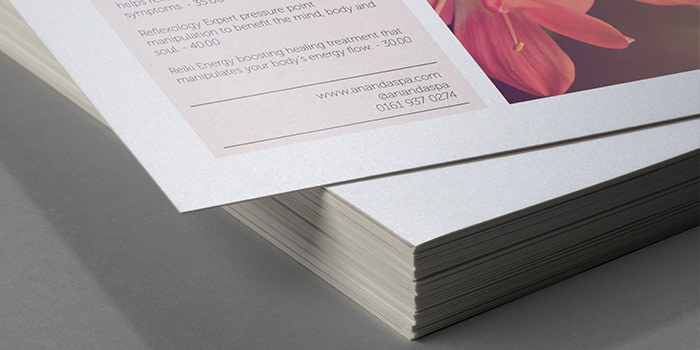
If you’ve ever compared Business Card paper weight across different printers, you’ve probably noticed that the measurements aren’t always consistent. That’s because points, pounds, and GSM measure different things. Here’s how each one works.
Points (pt)
Points measure the actual thickness, or caliper, of a sheet of paper or cardstock. One point equals 0.001 inches (0.0254mm). In other words, the higher the point value, the thicker the stock.
For example, 16pt cardstock measures approximately 0.41mm thick, while 32pt measures approximately 0.81mm.
Pounds (lb)
Pounds measure the weight of a ream of 500 sheets at a specified basis size. You’ll often see this written as 100lb, 130 lb, or 220lb.
There are different paper categories and basis sizes, including Cover (C) and Double Thick Cover (DTC). This matters because two stocks with the same pound rating can have different thicknesses depending on their composition and basis size.
DTC refers to two lighter sheets laminated together to create one heavier sheet.
GSM
GSM stands for grams per square meter. It’s a metric measurement of paper weight, calculated by weighing one square meter of paper.
It’s commonly used in Europe and gives you a consistent way to compare the mass of different paper stocks. However, GSM measures weight, not thickness. Two papers with the same GSM can still feel quite different in your hand.
When comparing Business Card paper thickness, it’s worth looking at all three measurements rather than relying on just one. And remember: Business Card size and thickness are two different things. If you’d like to learn more about card sizes, read our handy guide.
Business Card thickness compared: from 16pt to 32pt
Now that we’ve covered the measurements, let’s put them into context. Below is a comparison of different thicknesses, using MOO’s paper stocks as examples.
MOO Original cardstock: 16pt/350gsm
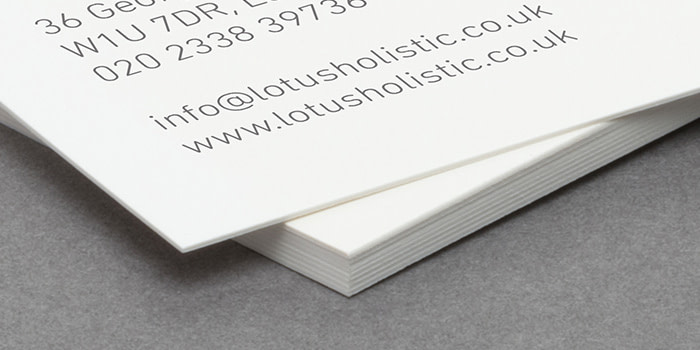
16pt Business Cards offer a substantial feel while remaining versatile enough for everyday use. MOO Original is a smooth, uniform stock available in Matte or Gloss finishes. It’s a great middle ground if you’re looking for quality and durability without going the extra mile.
MOO Feltmark cardstock: 17pt/298gsm

Thickness isn’t the only thing that determines how a card feels. MOO Feltmark has an uncoated surface with a distinct feltmark texture created during the papermaking process. It’s a great option if you want something tactile and memorable rather than a traditional smooth finish.
MOO Super cardstock: 18pt/380gsm
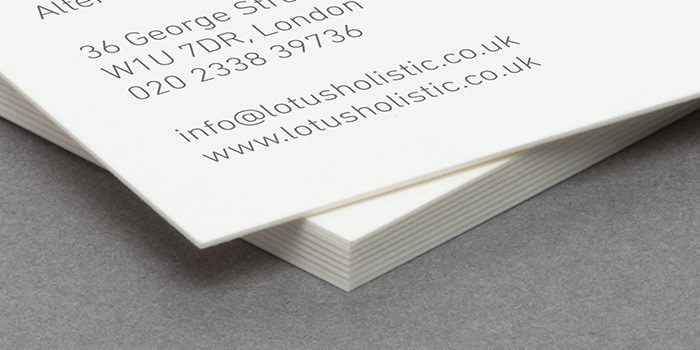
At 18pt, you’re getting a little more thickness and presence. Super has a silky-smooth surface and is available in Soft Touch or High Gloss finishes. It’s particularly suited to designs where you want the feel to play a bigger role in the overall impression.
But don’t just take our word for it – check out some of these awesome designs using MOO Super right here.
MOO Eco Signature cardstock: 19pt/352gsm

If sustainability is a priority, Eco Signature offers a different approach to Business Card stock. FSC certified and made from 100% post-consumer recycled material, it’s uncoated and has a natural paper feel. It’s a great way to make an impression on people and the planet.
MOO Luxe cardstock: 32pt/600gsm

If you want to make a bold statement, our Luxe Business Cards are your best bet. Carefully crafted from four layers of archival quality Mohawk Superfine paper, they’re extra thick, with a colorful seam that runs right through the middle.
Our Luxe cardstock is approximately the thickness of a bank card, making it a distinctive choice for designs where the physical feel is part of the experience.
What is the standard Business Card thickness?
16pt is a useful benchmark for standard Business Card thickness, offering a balance between durability, flexibility, and everyday practicality. Depending on the printer and the type of cardstock, you’ll commonly encounter options in the 14pt to 18pt range.
Thinner stocks can be suitable for high-volume distribution, while thicker options create a more substantial feel. Ultimately, the right choice depends on how you plan to use your cards. If you’re handing them out regularly at networking events, a versatile everyday stock might be all you need. If you’re creating cards for a special launch or want to make a bigger impression, a more substantial option could be worth considering.
Does thicker always mean better?
Not necessarily. When choosing your Business Card thickness, think about the impression you want to create, how often your cards will be handled, and where they’ll end up. A premium feel doesn’t always require the thickest possible paper. The best choice is the one that works for your design and the use case.
How thickness changes your finish options
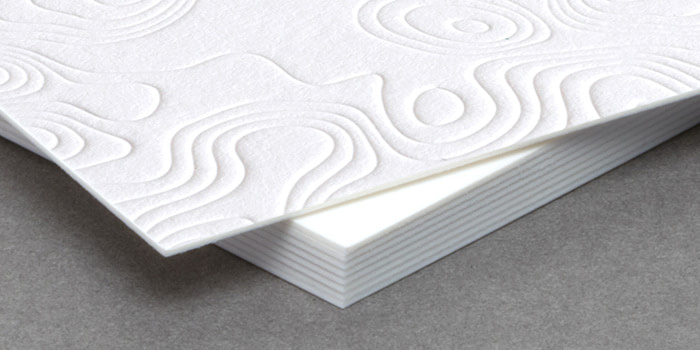
Your paper stock shapes which print finishes are available and how your finished design looks and feels.
Some finishes benefit from a more substantial stock. Letterpress, for example, uses pressure to create an impression in the paper, giving your design a tactile, debossed effect. A thicker stock can provide a more substantial surface for this kind of treatment.
Other finishes, such as Metallic Foil, also need to be considered alongside the paper’s construction and production requirements. Very thick or laminated stocks can affect how a card is finished, so it’s worth checking compatibility before finalizing your design. The key is to think about your stock and finish together, rather than treating them as separate decisions.
Not sure which texture suits your thick cards? Read our guide to the best business card paper finishes.
Find your perfect paper stock
Choosing the right Business Card thickness is easier when you can actually feel the difference. From the everyday versatility of Original to the distinctive construction of Luxe, there’s more than one way to make your design stand out.
Not sure which one is right for you? Order a free sample pack and compare how the stocks feel in your own hands before making your decision.
Frequently asked questions
What is the standard card thickness?
A standard Business Card is approximately 16pt, or 0.41mm thick. Many printers offer stocks ranging from around 14pt to 18pt, depending on the paper and finish. This range provides a balance between flexibility and durability, making it suitable for everyday networking and professional use.
Is 120 lb cardstock good for Business Cards?
Yes, 120lb cover stock can be a good option for Business Cards. As a general comparison, 120lb cover stock is roughly 16pt, or 0.40mm thick. However, pound ratings depend on the paper category and basis size, so always check the actual thickness specified by your printer before ordering.
Is 80 lb cardstock good for Business Cards?
It depends on the type of paper. An 80lb text stock is considerably lighter than 80lb cover stock, so the paper category matters just as much as the pound rating. For a traditional, substantial Business Card, look for a cover stock with a specified thickness rather than relying on the 80lb figure alone.
Which is thicker, 90 lb or 110 lb cardstock?
Generally, 110lb cardstock is heavier than 90lb cardstock within the same paper category. However, a higher pound rating doesn’t always mean a thicker sheet because the basis size and paper composition can differ. If you’re comparing two stocks, check their point or millimetre measurements for a more direct thickness comparison.
Keep in touch
Get design inspiration, business tips and special offers straight to your inbox with our MOOsletter, out every two weeks.
Share the post
Keep in touch
Get design inspiration, business tips and special offers straight to your inbox with our MOOsletter, out every two weeks.


